



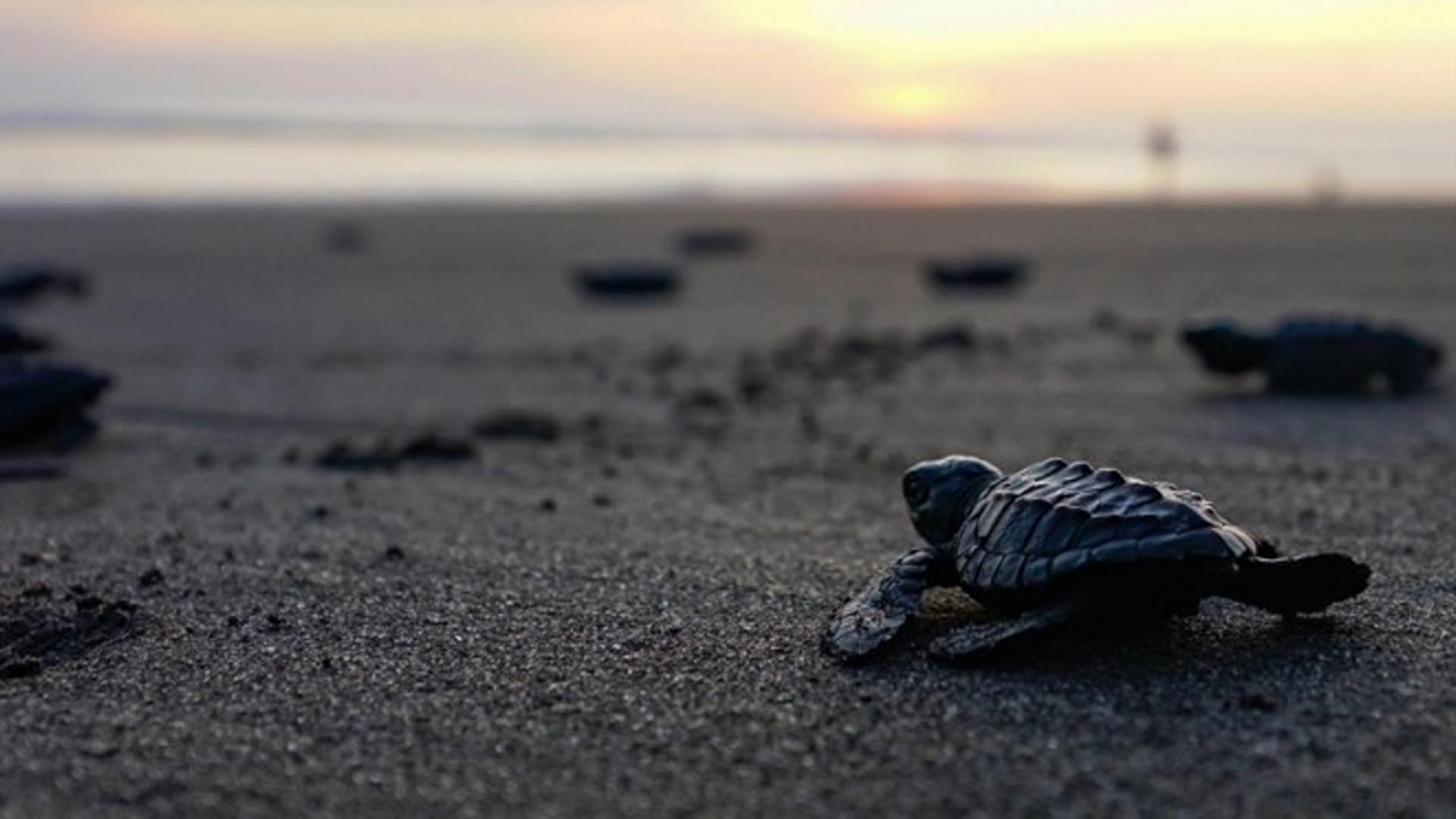







As the rapidly warming planet affects all life on earth, rising nest temperatures are increasing the female sea turtle population, according to a Turkish expert.
In an interview with Anadolu, Dogan Sozbilen, a board member of the Sea Turtle Research, Rescue, and Rehabilitation Center (DEKAMER), evaluated the effects of climate change and global warming on sea turtles.
Sea turtles are among the species directly affected by temperature, with the most significant impact on the determination of the sex of the hatchlings, Sozbilen said.
“When they lay their eggs in the sand, the sex of hatchlings is not determined; gender determination is not genetic but is influenced by environmental factors. At a nest temperature of 29 degrees Celsius on the beach, half of the hatchlings are female, and the other half are male.
When the temperature exceeds this, the number of females increases, while below this temperature, the number of males increases.”
“As temperatures rise and this trend continues, we face the problem of an increasing female population. Additionally, when temperatures reach 33-34 degrees Celsius, embryo deaths begin to occur,” Sozbilen said.
Sozbilen noted that due to rising temperatures, sea turtles will seek cooler habitats and reproduce at cooler times.
Predicting that climate change would significantly impact sea turtles, Sozbilen added: “Our studies and various projections have shown that sea turtles will not be able to cope with climate change in their current reproductive strategies by the year 2100.”
“Shifting their breeding times to cooler periods will not suffice as well,” he said, adding one of their studies published in 2023 found that nesting time shifts worldwide and could extend up to 180 days in the long term, but these changes alone will not be enough.
Importance of sea turtles for health of marine, coastal ecosystems
Sozbilen shared that there are seven species of sea turtles living in warm and tropical regions worldwide, with the loggerhead sea turtle (Caretta caretta) and the green sea turtle (Chelonia mydas) nesting on Türkiye’s Mediterranean coasts.
“Türkiye and Greece have the most loggerhead turtle nests in the Mediterranean. Nearly 80 percent of green sea turtle nesting occurs in Türkiye.”
He highlighted the important ecological roles sea turtles play for the health of both marine and coastal ecosystems. “Beaches, which are a crucial part of the coastal ecosystem, are nutrient-poor areas. By laying eggs on these beaches, sea turtles provide a food source for the plant and animal species sharing the habitat.”
Meanwhile, sea turtles help balance jellyfish populations by feeding on them, maintaining ecological equilibrium, he said.
Pollution problem
Pollution is a significant problem for the Mediterranean, Sozbilen said.
“Between 2017 and 2022, we measured pollution levels in the digestive systems of dead or injured sea turtles that washed ashore, with levels exceeding 80% and even reaching 100% in some areas.
In Türkiye, this rate is around 35%, but the areas where we conducted our studies are relatively clean. We see increasing rates in the Eastern Mediterranean.”
“Plastics can block sea turtles’ digestive systems, leading to a slow and painful death. Large pieces can entangle their flippers, causing them to become weak and unable to feed.”
Since 2000, every year on May 23, World Turtle Day is celebrated to raise awareness and concern for the turtle ecosystem. (PNA)