

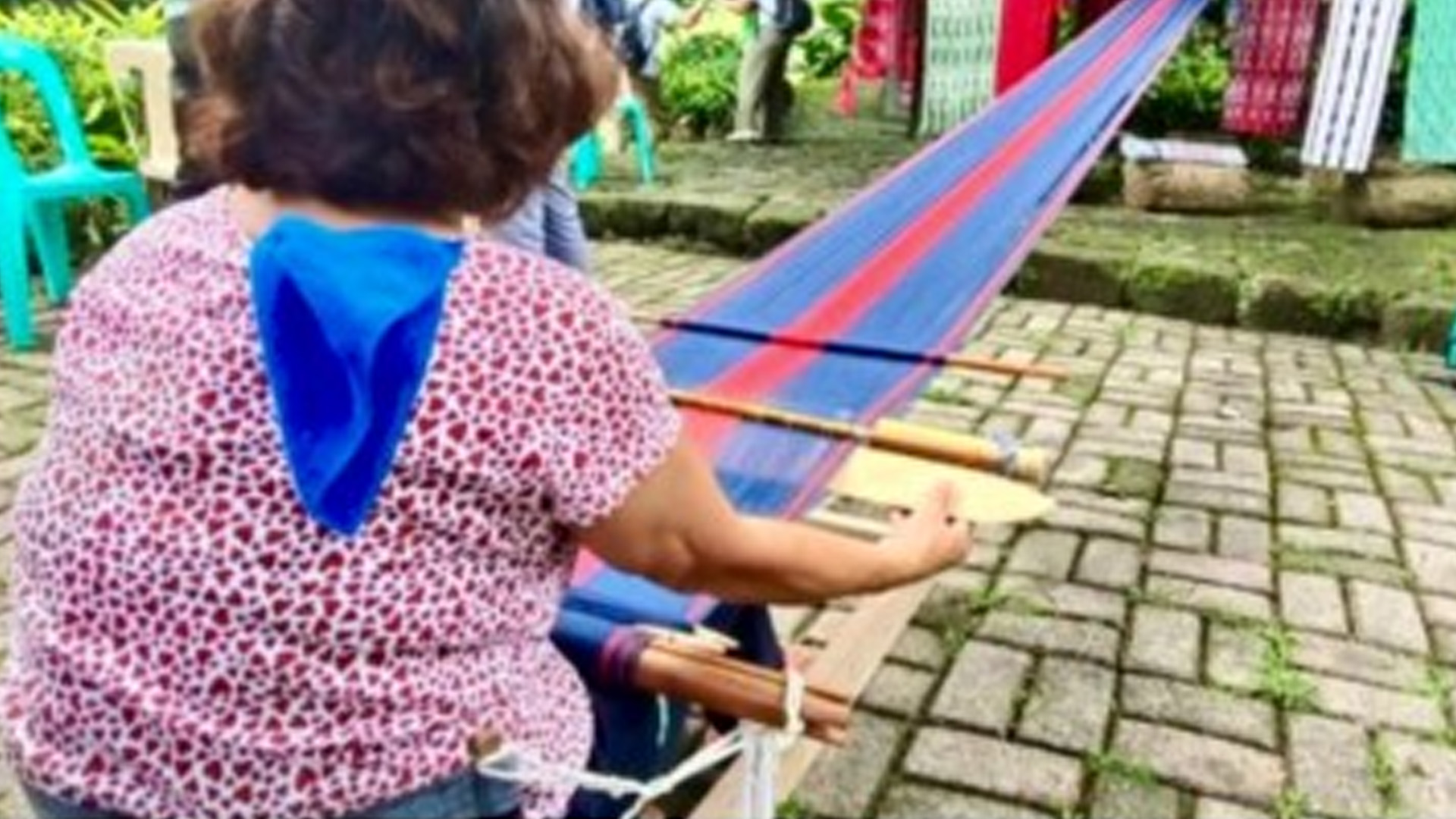







The push to preserve the world-renowned Ifugao rice terraces has also helped protect another important cultural treasure – the province’s centuries-old weaving tradition.
Marlon Martin, chief operating officer of the Save the Ifugao Terraces Movement (SITMO), said weaving was introduced as an additional source of income for rice farmers, ensuring that they continue cultivating “tinawon,” an heirloom rice variety used in rituals and for brewing bayah (rice wine).
“The money was no longer enough to sustain the needs of the modern Ifugao, like sending children to school. So, we thought of activities that could provide income without requiring many changes — weaving, which is also part of our culture,” Martin explained during a Department of Tourism-Cordillera familiarization tour in Kiangan, Ifugao, on Wednesday.
The tinawon rice takes nearly 10 months to grow, producing a low economic yield since most of it is kept for household use or rice wine production.
To prevent farmers from abandoning their fields, SITMO sought alternative livelihood options tied to cultural heritage.
Weaving as livelihood
“We thought of weaving because it is part of Ifugao culture and a source of income that doesn’t require waiting too long before they get paid,” Martin said.
At present, SITMO has more than 60 weavers, with about 45 actively working at the Indigenous Peoples Education (IPEd) Center.
Initially, their products followed traditional designs, but as demand grew, weavers adapted styles demanded by clients while still respecting tradition.
“It was not just the weavers who had to convince themselves to evolve but including me so that we can provide what is needed and at the same time, sustain the financial needs of the weavers while also achieving the goal of terrace conservation,” Martin said.
Aside from simple fabrics, weavers have also learned to produce apparel and other items.
To minimize fabric wastage, even small leftover pieces are turned into mixed designs or small craft items.
SITMO ensures weavers are immediately paid for their work rather than waiting for items to be sold.
Their products are displayed at “Ifugao Nation,” a Kiangan store that also features hand-carved woodcrafts, blacksmith works, and bamboo products made by farmer-artisans.
Passing on a tradition
For weaver Divine Balangtao Calingayan, 37, weaving has been part of life since childhood.
“I started weaving when I was small, watching my mother,” she told the Philippine News Agency.
“In high school, I made small pieces, but I stopped when I went to college, got married, and raised my children,” she shared.
Now, she encourages her 17- and 18-year-old daughters to weave in their spare time, helping them earn extra and save for their future.
“They don’t yet fully grasp cultural preservation, but at least they are starting to see weaving’s relevance in their lives,” she said.
Sustaining culture, lives
For SITMO, the advocacy has a long way to go, stressing the need for national government support.
“We hope that social pension and other aid also look at the welfare of the advocates for cultural preservation who also need to survive economically and send their children to school,” Martin said in a mix of Ilocano and Filipino.
He added that SITMO values the hard work of its weavers, who spend days completing several yards of fabric.
“We properly compute the effort so that we can estimate the price of an item. An apparel, for example, is the product of many skills and hearts — the weaver, the sewer, the embroiderer — all coming together before it reaches the final user,” Martin said. (PNA)