



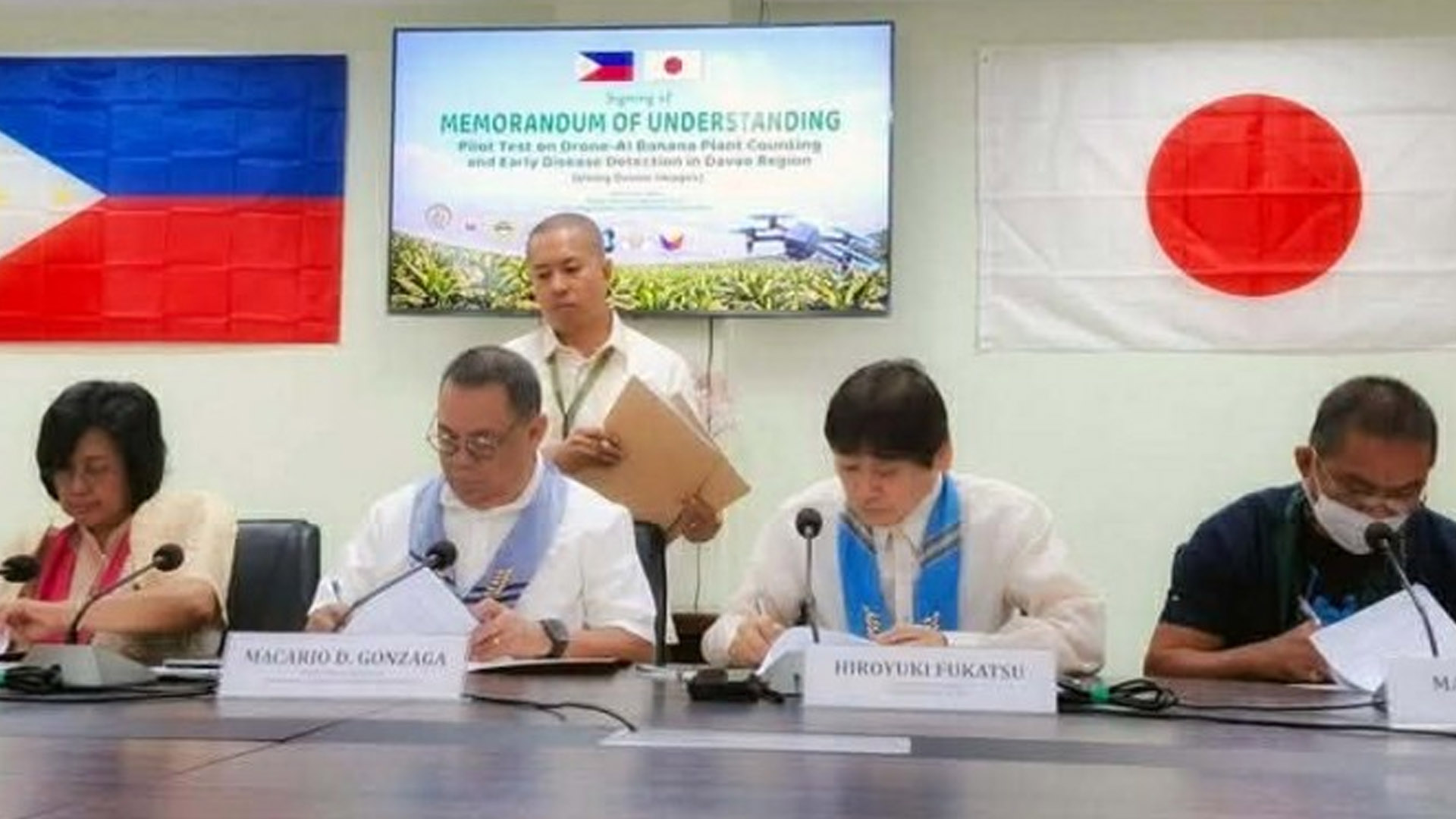







The Department of Agriculture in Davao Region (DA-11) signed a memorandum of understanding Monday with Japanese firm E-Supportlink Co., Ltd. to launch an artificial intelligence (AI)-powered drone pilot project for banana plant counting and early disease detection.
The banana industry is a major contributor to the Philippine agricultural economy, particularly in Mindanao. However, challenges such as the spread of Fusarium wilt and the lack of accurate plantation data continue to affect production and management, with traditional monitoring methods remaining labor-intensive and limited in coverage.
Experts said Fusarium wilt, a soil-borne fungal disease, causes yellowing, wilting, brown vascular discoloration and ultimately, plant death. It can attack tomatoes, bananas and cotton plantation.
In an interview, DA-11 Regional Director Macario Gonzaga said the pilot testing will cover farms in Davao del Norte and Davao de Oro, targeting a total project area of 15 hectares. Pilot testing was conducted at Laserna Farm in Ula, Tugbok District, Davao City in the afternoon.
“We will see how effective the technology is in detecting banana diseases,” Gonzaga said.
The project employs AI-assisted analysis of multispectral drone imagery to identify banana plants infected with targeted diseases during the presymptomatic stage.
The Department of Science and Technology will regularly monitor project implementation, including drone operations, AI analysis, and field validation.
“Up to now, we have not yet found the true solution to combat Fusarium wilt,” Gonzaga added.
Drone technology, combined with AI and remote sensing, is expected to improve plantation mapping, plant population estimation and early disease detection, enabling faster and more efficient monitoring and response.
“Once proven effective, we will campaign this to all banana growers. Especially the small-scale banana growers, we will help them with this drone technology,” Gonzaga said.
The project also ensures sustainability through training DA personnel and farm managers on drone and AI applications. Manuals and operational guidelines will be developed, drone-AI outputs will be integrated into DA monitoring systems, and a digital database for plantation mapping and disease surveillance will be established.
“Japanese nationals love our banana variety, that’s why they extend help through this technology for us to improve banana production in the region,” he said. (PNA)