



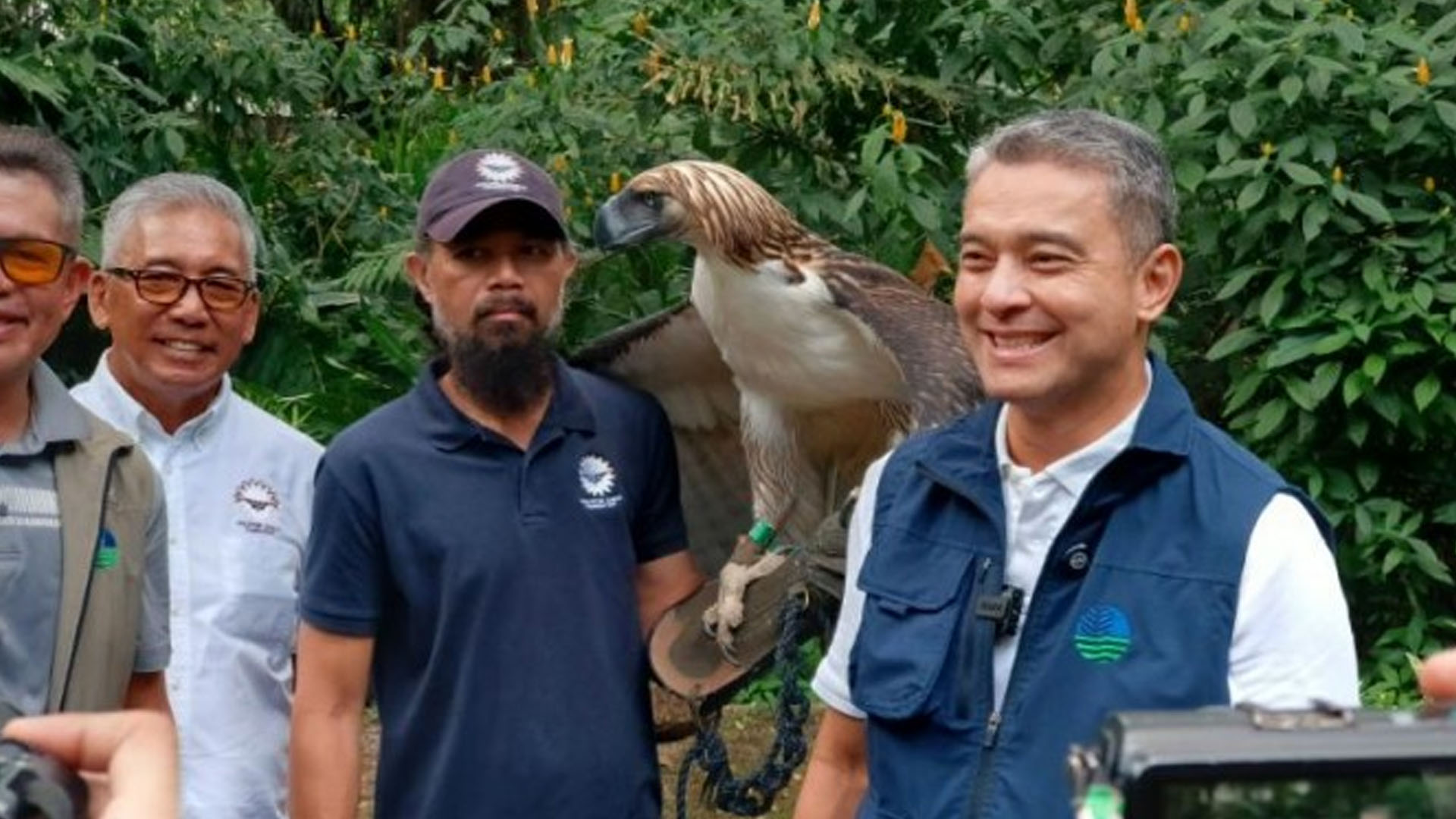







Protecting the endangered Philippine eagle will extend beyond the Philippine Eagle Center (PEC), as the government, conservation groups and Indigenous Peoples (IP) communities launched two planning initiatives Tuesday that will bring conservation work into ancestral domains and biodiversity landscapes in Eastern Mindanao.
During the launch held at the PEC in Malagos, Davao on Tuesday, Department of Environment and Natural Resources Secretary Juan Miguel Cuna hailed the landmark partnership between the agency, the Philippine Eagle Foundation (PEF), Department of Tourism (DOT) Region 11, National Commission on Indigenous Peoples (NCIP) and IP communities.
“The Philippine Eagle is a magnificent symbol of our national identity, our natural heritage, and the biological wealth of our country. Yet, today, it remains critically endangered and faces a very high risk of extinction in the wild,” Cuna said.
PEF Director for Operations Jason Ibanes said that only 392 pairs of Philippine eagles remain across Luzon, Eastern Visayas and Mindanao.
The data also shows that Mindanao remains its main stronghold, but habitat loss and avoidable deaths, especially of young eagles trying to reach maturity, continue to threaten its survival.
“This is an urgent call to action. We do not have the luxury of time. Every single forest patch we keep intact, every active nest we safeguard, and every avoidable eagle death we prevent matters directly to the survival of this species,” Cuna added.
He said the initiative will map out the development of the PEC as an eco-cultural tourism destination, an educational park and a conservation academy.
The proposed five-year planning process will cover stakeholder consultations, review of tourism products and policies, development of the academy, integration of indigenous knowledge, eco-cultural tourism, climate resilience and visitor experience.
The other will focus on selected ancestral domains within the Eastern Mindanao Biodiversity Corridor, where the partners will enhance the Ancestral Domain Sustainable Development and Protection Plan (ADSDPP) and support community conservation planning.
The planning will combine customary governance and Indigenous knowledge with conservation science, ecosystem management, spatial planning and community-based monitoring.
Cuna said the initiatives recognize Indigenous communities as rights holders, knowledge holders, conservation partners, and decision-makers within their ancestral domains.
“Many of the sustainable nesting sites ng ating Philippine eagle ay nasa ancestral domain, kaya nandito ang mga Indigenous Peoples natin and leaders dahil gusto natin magtulungan tayo, ma-integrate ang kanilang traditional indigenous knowledge na alam nila since umiikot ang Philippine Eagle natin sa lugar nila, ancestral domains, na alam nila kung paano alagaan ang mga ito (of our Philippine eagle is in the ancestral domain, that’s why our Indigenous Peoples and leaders are here because we want to work together, to integrate their traditional indigenous knowledge that they know since our Philippine Eagle revolves around their area, ancestral domains, where they know how to take care of these),” he said.
“So ito ang pag-educate sa kanilang mga tao na itigil na ang pagbabaril sa ating mga eagle, yung mga minsan nahuhuli sa mga traps, actually yung mga traps na itinatayo para sa mga deer o mga baboy ramo pero naiipit yung mga eagles noon (this is about educating their people to stop shooting our eagles, those that sometimes get caught in traps, actually the traps set up for deer or wild boars but end up trapping the eagles),” he added.
Cuna also said that through the program, IPs will be taught watershed management and wildlife conservation, among other topics.
IP leader Datu Rodino Domogoy of the Manobo tribe thanked the DENR and the PEF for recognizing them as partners in protecting and conserving the Philippine eagle.
“Maraming salamat sa ating mahal na secretary na binigyan at kinikilala ang mga nagawa at kakayahan ng mga katutubo na pagprotekta ng kalikasan at dito sila tinuturuan at sinasabi ng gobyerno na dapat protektahan natin ito sa mga ninuno pa po namin yan (Thank you very much to our esteemed secretary for recognizing and acknowledging the achievements and capabilities of the Indigenous People in protecting nature, and for teaching them here and saying that we should protect this as it has been passed down from our ancestors),” he said.
He also appealed to all the IP communities nationwide to help in the protection of wildlife species.
“Sa mga katutubo na nandito at sa lahat ng katutubo sa Pilipinas na protektahan po natin ang ating kalikasan at wildlife na namumuhay sa kagubatan. Nais kong ipaabot sa kanila na isapuso nila ang kanilang pagprotekta, hindi lang sa salita, kundi nasa gawa talaga (To the Indigenous People here and around the country, let us protect our nature and wildlife that live in the forests. I want to tell them to truly embody protecting the wildlife, not just in words, but in actions),” he said. (PNA)